Compare DTG/DTF hybrid printers and dedicated DTF printers.
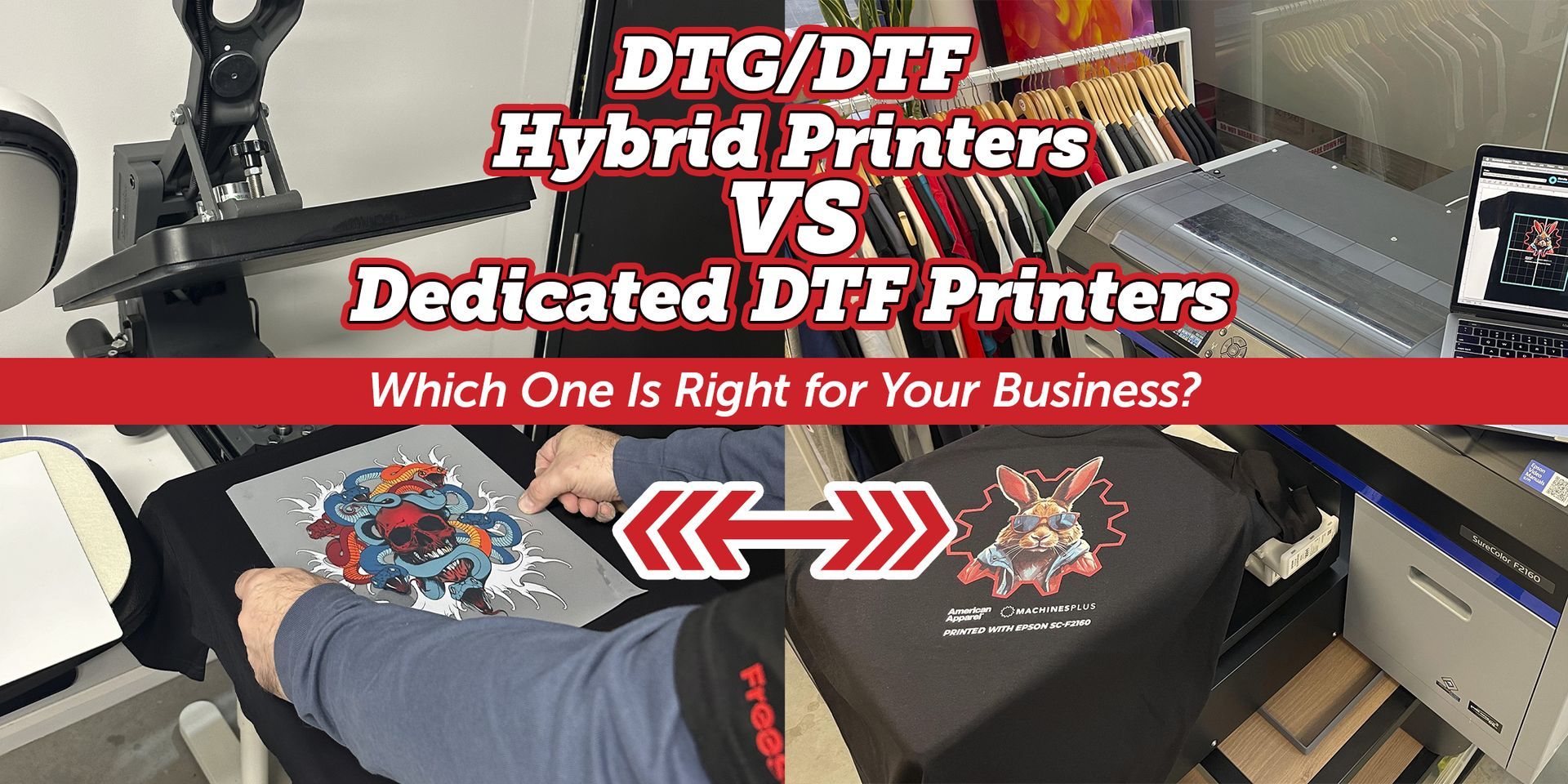
Learn which option suits your garment printing workflow, production volume and business goals.
The garment printing industry has changed quickly over the last few years.
DTG printing is still a strong option for high-quality cotton garments. DTF printing has grown fast because of its flexibility across different fabrics. Now, many businesses are asking the next logical question:
Should I buy a DTG/DTF hybrid printer, or should I invest in a dedicated DTF printer?
The honest answer is: it depends on your workflow.
There is no perfect machine for every business. A hybrid DTG/DTF printer and a dedicated DTF printer both have a place. The right choice depends on what you print, how much you print, what garments you use, and where your business is heading.
What Is a DTG/DTF Hybrid Printer?
A DTG/DTF hybrid printer is a machine that can print directly onto garments using DTG and can also produce DTF transfers using film.
This gives a business two production options from one printer:
- DTG printing directly onto suitable garments, especially cotton
- DTF transfer printing onto film, which can then be pressed onto garments later
For many small to medium businesses, this flexibility is a major advantage. Instead of committing to one print method only, a hybrid printer allows you to offer both.
What Is a Dedicated DTF Printer?
A dedicated DTF printer is built specifically for producing DTF transfers.
The design is printed onto film, adhesive powder is applied, the transfer is cured, and then it is heat pressed onto the garment.
Dedicated DTF systems are usually better suited to businesses that want to produce larger volumes of transfers, especially when paired with an inline shaker and dryer.
This type of setup is designed for production efficiency, repeatability and transfer output.
The Main Difference
The simplest way to explain it is this:
A DTG/DTF hybrid printer is built for flexibility. A dedicated DTF printer is built for DTF production volume.
That does not mean one is better than the other.
It means they are designed for different business needs.
DTG/DTF Hybrid Printers: The Advantages
A hybrid printer is attractive because it gives you more options from one machine.
1. More Flexibility
With a hybrid printer, you can choose the best method for the job.
For example, you may use:
- DTG for premium cotton T-shirts
- DTF for polyester, blends or difficult garments
- DTF transfers for later production
- DTG for soft-feel retail-style prints
- DTF for small logos, awkward placements or repeat jobs
This is valuable because customers rarely ask for one neat category of work. One day it may be cotton T-shirts. The next day it may be hoodies, workwear, sportswear or mixed garments.
A hybrid printer helps you adapt.
2. Lower Entry Barrier
For businesses that are still building volume, buying separate DTG and DTF systems may not make commercial sense straight away.
A hybrid printer can allow you to enter both markets without over-investing too early.
This is especially useful if you are still testing:
- Which services your customers want
- What garment types sell best
- Whether your market prefers DTG, DTF or both
- How much production volume you can realistically generate
It gives you room to grow without locking yourself into one workflow too soon.
3. Better Use of Space
Not every business has room for multiple production lines.
A hybrid printer can be useful for:
- Home-based print businesses
- Small shops
- Startups
- Existing businesses adding garment printing
- Businesses with limited production space
If space is tight, one flexible machine may be a better fit than two separate systems.
4. Good for Mixed Custom Work
Hybrid printers suit businesses that do a variety of jobs rather than one specific type of high-volume production.
For example:
- One-off custom T-shirts
- Small business uniforms
- Personalised gifts
- Event merchandise
- Small runs
- Online orders
- Local customer work
This kind of business usually needs flexibility more than pure speed.
DTG/DTF Hybrid Printers: The Limitations
A hybrid printer is not a magic machine.
It is flexible, but that does not automatically make it the best option for high-volume DTF transfer production.
1. Not Always the Fastest DTF Workflow
If your business is producing gang sheets all day, every day, a dedicated DTF printer with an inline shaker and dryer will usually be more efficient.
Hybrid machines are often better suited to controlled, flexible production rather than heavy transfer manufacturing.
2. Workflow Changes Matter
Switching between DTG and DTF is not something you should treat casually. You still need to understand the process, settings, film, powder, curing and finishing.
A hybrid printer gives you options, but you still need discipline.
Poor process creates poor results, regardless of the machine.
3. Production Planning Is Still Required
If you are doing both DTG and DTF on one printer, you need to manage scheduling properly.
For example:
- When are you printing direct to garment?
- When are you producing transfers?
- Are you batching DTF work?
- Are you managing pretreatment, curing and pressing correctly?
- Are you keeping the machine maintained?
Flexibility is powerful, but only if the workflow is controlled.
Dedicated DTF Printers: The Advantages
Dedicated DTF printers are a strong option when your business is focused on transfer production.
1. Built for DTF Volume
If DTF is your main product, a dedicated DTF system is usually the cleaner production choice.
This is especially true if you are producing:
- Gang sheets
- Bulk transfers
- Trade supply transfers
- Regular uniform logos
- Repeat customer orders
- Sportswear and workwear transfers
A dedicated system is built around that workflow.
2. More Efficient Production
Dedicated DTF setups often work better when paired with powdering and curing equipment.
This can make production smoother because the process is designed around transfer output from start to finish.
For higher-volume businesses, that matters.
Speed is not just about how fast the printer runs. It is also about how efficiently the whole workflow operates.
3. Better for Transfer Supply Businesses
If your business model is supplying transfers to other businesses, a dedicated DTF printer usually makes more sense.
In that case, you are not just printing garments. You are manufacturing transfers as a product.
That requires:
- Consistent output
- Repeatable quality
- Efficient curing
- Good film handling
- Reliable powder application
- Production capacity
A dedicated DTF system is generally better suited to that model.
Dedicated DTF Printers: The Limitations
Dedicated DTF printers are powerful, but they are not the right choice for everyone.
1. Less Flexible Than a Hybrid Printer
A dedicated DTF printer does one main job: produce DTF transfers.
If you also want to print directly onto garments using DTG, then a dedicated DTF printer will not give you that option.
You may eventually need a separate DTG printer if your customers want soft-feel cotton prints or premium direct-to-garment production.
2. Higher Workflow Commitment
A dedicated DTF setup often means you are committing more seriously to DTF as a production model.
That can be a good thing if you have the volume.
But if you are still testing the market, it may be more machine than you need at the beginning.
3. Space and Setup Requirements
Dedicated DTF production can require more space, especially if you are using:
- Inline shaker
- Dryer
- Powder storage
- Film rolls
- Transfer storage
- Heat press stations
- Ventilation or extraction considerations
This should be planned before purchasing.
Buying the machine is only one part of the decision. The full workflow matters.
Quick Comparison: Hybrid vs Dedicated DTF
Option: DTG/DTF Hybrid Printer
Best For: Businesses wanting flexibility across DTG and DTF
Main Advantage: One machine supports multiple workflows
Main Limitation: Not always ideal for high-volume DTF transfer production
Option: Dedicated DTF Printer
Best For: Businesses focused mainly on DTF transfers
Main Advantage: More production-focused DTF workflow
Main Limitation: Does not offer direct-to-garment printing
When a DTG/DTF Hybrid Printer Makes Sense
A hybrid printer may be the right choice if you:
- Want to offer both DTG and DTF
- Are still building your garment printing volume
- Need flexibility across different customer requests
- Work with cotton garments but also need transfer options
- Have limited space
- Want to avoid buying two separate machines immediately
- Produce one-offs, small runs or mixed jobs
- Want to test the market before committing to full DTF production
For many growing businesses, this is the smarter starting point.
It gives you more ways to say yes without overcommitting too early.
When a Dedicated DTF Printer Makes Sense
A dedicated DTF printer may be the better option if you:
- Already know DTF will be your main workflow
- Produce gang sheets regularly
- Need higher transfer output
- Supply transfers to other businesses
- Print a lot of workwear, sportswear or mixed fabrics
- Need a more streamlined transfer production setup
- Already have enough order volume to justify the system
If DTF is your core business, a dedicated DTF setup is usually the stronger long-term production tool.
The Real Question Is Not “Which Machine Is Better?”
The better question is:
What type of work are you actually trying to produce?
A business doing premium cotton T-shirts, custom one-offs and mixed local jobs may benefit more from a hybrid printer.
A business producing hundreds of transfers per day may be better suited to a dedicated DTF system.
A business doing both may eventually need both.
That is the honest commercial reality.
Do Not Buy Based on Trends Alone
DTF is popular, and for good reason. It is flexible, practical and useful across a wide range of garments.
But popularity does not automatically make it the right solution for every business.
The same applies to hybrid printers. Flexibility is valuable, but only if it matches your workflow.
Before choosing equipment, ask:
- What garments do I print most often?
- What fabrics do my customers use?
- How many orders do I produce each week?
- Do I need soft-feel DTG prints?
- Do I need transfer storage?
- Am I doing custom work or production work?
- Do I have the space for a full DTF workflow?
- Am I building volume or already producing volume?
The right answer comes from the business model, not from hype.
Final Thoughts
DTG/DTF hybrid printers and dedicated DTF printers both have a place in modern garment printing.
A hybrid printer gives you flexibility.
A dedicated DTF printer gives you production focus.
Neither option is automatically better.
The right machine depends on your garments, your customers, your order volume, your space and your long-term business goals.
At Machines Plus, we believe the best equipment choice should be based on the workflow, not just the latest trend.
If you are not sure whether a DTG/DTF hybrid printer or a dedicated DTF printer is the right fit for your business, speak to our team. We can help you compare the options and choose a setup that makes commercial sense.